Full-Depth Reclamation (FDR) vs. Remove-and-Replace
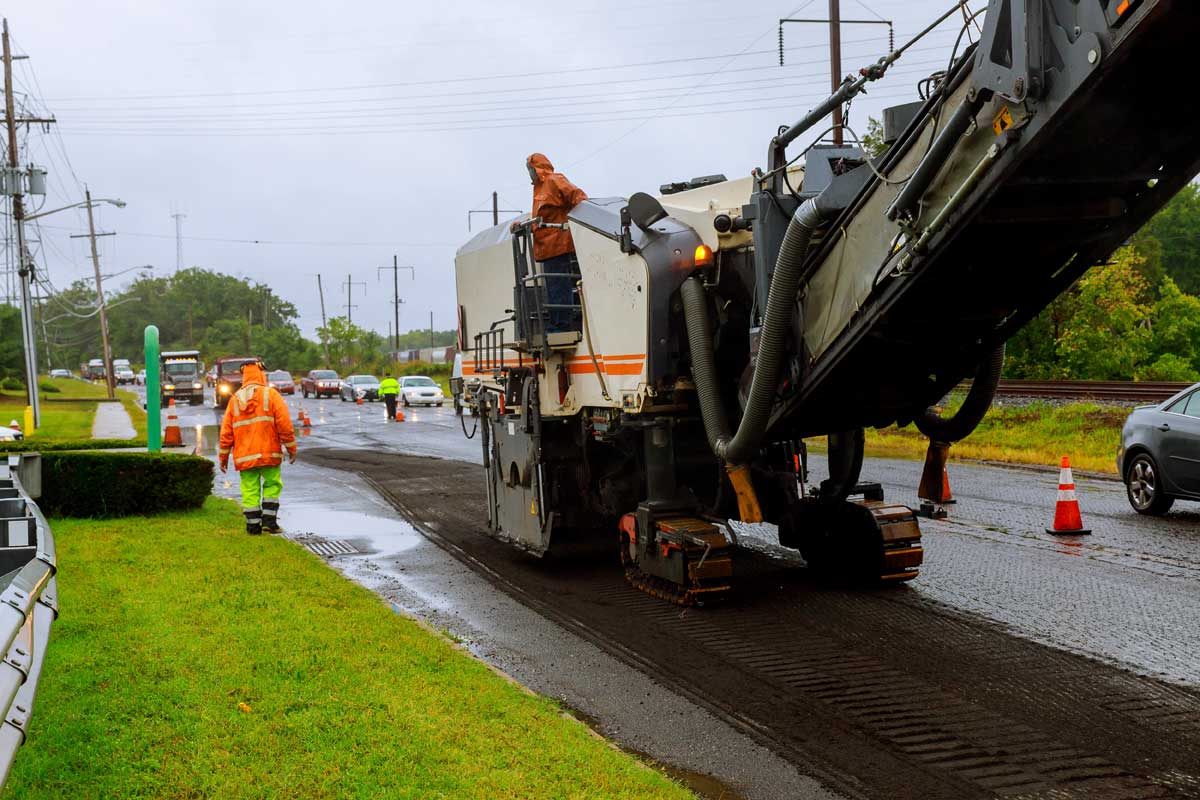
Picking the Right Rebuild Strategy for Worn-Out Pavements
Why These Two Methods Dominate Heavy-Rebuild Work
When pavement distress goes beyond what crack sealing, patching, or mill-and-overlay can handle, agencies usually narrow the field to two heavyweight contenders:
| Approach | Core Idea | Typical Depth | Typical Traffic Disruption |
|---|---|---|---|
| Full-Depth Reclamation (FDR) | Pulverize the existing asphalt and base in-place, blend with stabilizer (cement, lime, or emulsion), compact, then pave new hot-mix (or cold-in-place) surface. | 6-12 in. | 1-2 lanes closed; traffic can sometimes ride the stabilized base the same day. |
| Remove-and-Replace (R&R) | Excavation or cold-milling removes all pavement layers down to virgin subgrade; new granular base and new asphalt (or concrete) section are placed. | 8 in.-18 in. | Full closure or detour is common; longer work windows needed. |
Process Deep-Dive
Full-Depth Reclamation
-
Pre-design sampling & FWD testing
-
Cold recycler/pulverizer grinds 100 % of the asphalt plus set base depth
-
Stabilizing agent injected and mixed
-
Water added to reach optimum moisture
-
Material compacted & graded
-
Curing (24-72 h)
-
New surface lift(s) paved
Remove-and-Replace
-
Saw-cut limits, mill or excavate out existing structure
-
Haul to disposal/recycling site
-
Subgrade proof-roll and under-cut soft spots
-
Import and place new aggregate base
-
Place and compact binder & surface courses (or PCC slab)
-
Cure-time or cool-down before opening
Cost & Schedule Comparison
| Metric | Full-Depth Reclamation | Remove-and-Replace |
|---|---|---|
| Unit Cost | ≈ $16-$25 per sq yd depending on stabilizer and thickness (savemyroad.com, cassidypaving.com) | ≈ $8-$15 per sq ft ($72-$135 per sq yd) for full teardown and new asphalt in 2025 (angi.com, todayshomeowner.com) |
| Haul-truck trips | 60-70 % fewer (no export/import of bulk material) (savemyroad.com) | Highest of any rehab option |
| Construction window | 30-50 % shorter; often 1-2 weeks per mile | 3-6 weeks per mile |
| Lifecycle (w/ 2-in overlay) | 20-25 yrs before next major work | 25-30 yrs, but higher first cost |
| CO₂ footprint | Up to 70 % less due to in-place recycling (savemyroad.com) | Highest emissions of common methods |
Rule of Thumb: If the subgrade is fundamentally sound and the pavement hasn’t pumped fines into the base, FDR often delivers ~35 % cost savings over R&R with similar life expectancy. (savemyroad.com, cement.org)
Performance & Risk Factors
| Factor | FDR Best Fit | R&R Best Fit |
|---|---|---|
| Widespread fatigue / alligator cracking | ✔ | ✔ |
| Deep subgrade failure / pumping | ✖ — subgrade fix still needed | ✔ |
| Need to raise grade line? | Moderate increase (2–4 in.) | Any change possible |
| Urban work zone with tight haul routes | ✔ (minimal trucking) | ✖ |
| Agency specs require virgin materials | ✖ | ✔ |
| Recycling / sustainability goals | ✔ | ✖ |
Decision Flowchart
-
Visual + Core Distress Survey → fatiguing only top layers? → consider mill-and-overlay before rebuild.
-
Falling-Weight Deflectometer (FWD) & GPR
-
Deflections low / base intact → FDR candidate
-
Deflections high, voids, subgrade pumping → R&R or deep undercut
-
-
Budget & Traffic Sensitivity
-
If night-work or weekend reopening critical, FDR’s faster cycle wins.
-
-
Final LCCA (Life-Cycle Cost Analysis) including salvage value, road-user delay costs, and carbon price (if agency uses).
Mini-Case Study: Lake County, OH County Route 512
-
4-lane rural arterial, PCI = 38, severe rutting
-
Engineering estimate: R&R $3.8 M vs. FDR $2.4 M (same 3-mile segment)
-
Chose FDR with 6 in. emulsion-stabilized base + 2.5 in. SMA surface
-
Opened to traffic 14 days sooner; post-construction FWD shows 40 % stiffness gain
-
Five-year ride-quality surveys show IRI = 52 in/mi (excellent)
Key Takeaways for Decision Makers
-
Test, don’t guess: Core & FWD data drive the rebuild choice—not just surface distress.
-
Quantify user delay: Add road-user costs to capture FDR’s faster reopening advantage.
-
Plan the surface too: FDR bases can carry thin hot-mix, cold-in-place recycling, or chip seal, tailoring budget and performance.
-
Mind utilities & grade constraints: R&R enables major profile changes and utility replacement; FDR does not.
-
Don’t forget quality control: Cure moisture & compaction are critical in FDR; density & lift-thickness control dominate R&R.


Life-Cycle Assessment of Pavement Alternatives: Quantifying Environmental Impacts from Cradle to Grave

When Is the Best Time of Year to Sealcoat?

Poor Subgrade Support: Detecting and Fixing the Root of Premature Rutting

Developing a Pavement Rehabilitation Plan Based on PCI Data

Joint Resealing & Spall Repair for Concrete Roads
