Optimal Base and Sub-Base Layer Thicknesses for Rural vs. Urban Roads
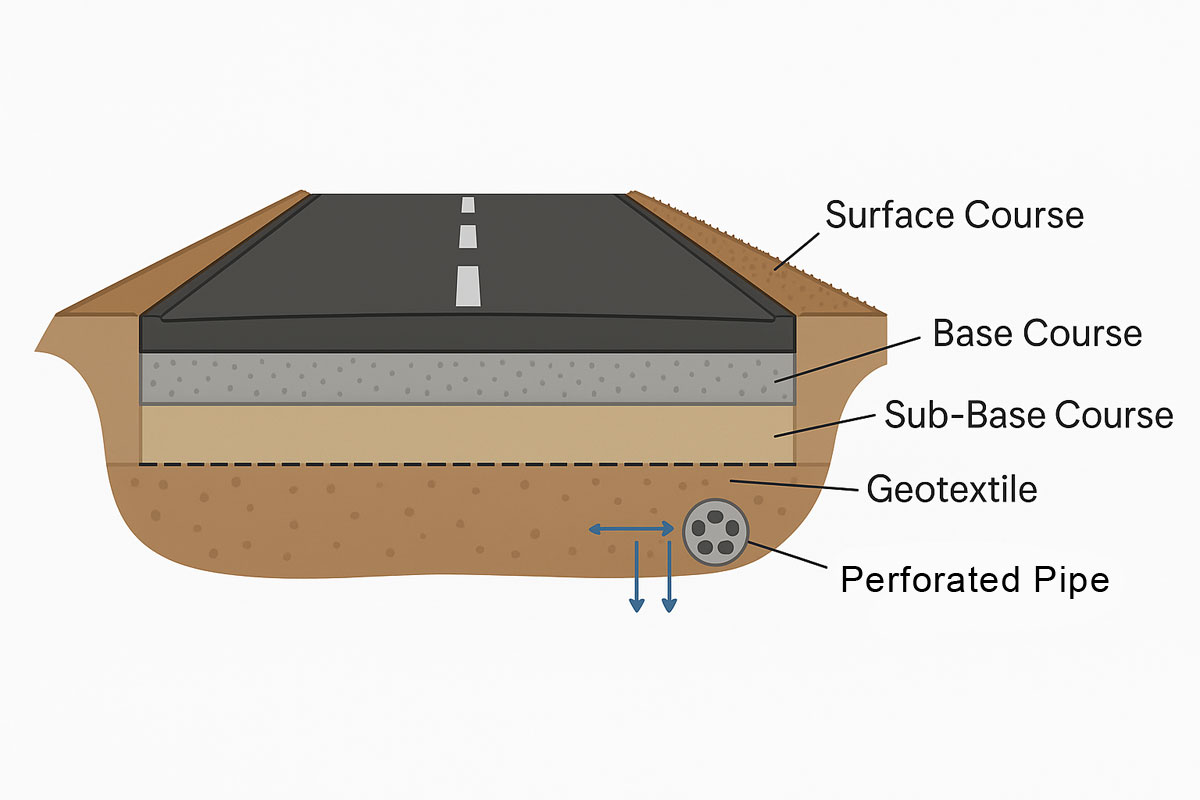
The base and sub-base layers sit between your surface course (asphalt or concrete) and the native subgrade. They distribute traffic loads, provide frost protection, and create a stable platform for paving equipment. Because traffic volumes, truck percentages, and utility demands vary dramatically between a quiet farm lane and a downtown arterial, the “right” thickness is never one-size-fits-all. This article walks through the factors that govern layer thickness and gives practical thickness ranges you can use as a first pass when designing or rehabbing rural and urban pavements.
Why Thickness Matters
| Layer | Primary Role | Failure Mode If Too Thin |
|---|---|---|
| Base (granular or bound) | Spreads wheel loads, adds stiffness | Rutting, fatigue cracking |
| Sub-base (lower-quality granular or stabilized soil) | Drainage, frost protection, working platform | Loss of support, pumping, melting frost heave |
An undersized base/sub-base usually shows up as premature surface distress and higher life-cycle costs. Conversely, over-building inflates construction costs with no service-life benefit beyond a certain point, especially painful for tax-funded projects.
Design Factors That Drive Thickness
-
Traffic Loading (ESALs) - Equivalent Single-Axle Loads over the design life.
-
Subgrade Strength - CBR or R-value; the weaker the subgrade, the thicker the aggregate or stabilized layers need to be.
-
Environment - Freeze-thaw depth, precipitation, and temperature swings dictate how aggressive you must be about drainage and frost protection.
-
Functional Classification - Rural local, rural collector, urban arterial, etc., each carries its own reliability target and truck percentage.
-
Utility Cuts & Reconstruction Frequency - Urban corridors suffer more cuts; a thicker bound base or concrete base resists trench-related settlements.
Typical Materials
| Layer | Rural Preference | Urban Preference |
|---|---|---|
| Base | 100 % crushed aggregate; occasionally Otta seal | Dense-graded aggregate, asphalt-treated base (ATB), cement-treated base (CTB), roller-compacted concrete (RCC) |
| Sub-base | Granular “select fill,” recycled asphalt pavement (RAP) blend | Granular sub-base with geosynthetic separator or lean concrete sub-base |
Thickness Guidelines , Rural Low-Volume Roads
Assumptions: < 400 ADT (Average Daily Traffic), < 10 % trucks, AASHTO Reliability 75 %, frost depth ≤ 3 ft.
| Subgrade CBR | Sub-Base (in) | Base (in) | Notes |
|---|---|---|---|
| > 10 | Optional 4-6 | 4-6 | On well-drained, high CBR soils a sub-base may be omitted. |
| 5 - 10 | 6 | 6 | Add woven geotextile if water table approaches sub-base bottom. |
| < 5 | 8-10 | 6-8 | Consider lime-treated sub-grade to cut aggregate thickness by ≈ 25 %. |
Key rural takeaways
-
Keep the base relatively thin and focus on drainage; water is the #1 enemy on lightly loaded pavements.
-
Stabilization (lime, cement, enzyme) can save on aggregate haul costs in remote areas.
Thickness Guidelines , Urban Collectors & Arterials
Assumptions: 1 000 - 15 000 ADT, 10-15 % trucks, Reliability 90-95 %, frequent utility activity.
| Traffic Class | Subgrade CBR | Sub-Base (in) | Base (in) | Popular Urban Options |
|---|---|---|---|---|
| Local/Collector (< 50 000 ESAL/yr) | ≥ 7 | 8-10 | 6-8 | Dense-graded aggregate base (DGA) |
| Minor Arterial (50 000-200 000 ESAL/yr) | ≥ 5 | 10-12 | 8-10 | 4 in CTB + 4 in DGA |
| Principal Arterial (> 200 000 ESAL/yr) | 3-5 | 12-14 | 10-12 | 6 in RCC or ATB + 6 in select granular sub-base |
Urban insights
-
Bound or semi-bound bases (CTB, ATB) arrest rutting and survive utility trenches better than pure aggregate.
-
Geosynthetic separators are cheap insurance against fines pumping onto traffic-signal conduits and other buried assets.
-
In CBD settings, a lean concrete sub-base (LCB) 4-6 in thick over a granular sub-base virtually eliminates reflective cracking in JRCP overlays.
Quick-Look Comparison Table
| Context | Typical ESAL Range (20 yr) | Sub-Base Thickness | Base Thickness | Frost/Drainage Add-Ons |
|---|---|---|---|---|
| Rural Local | 50 k - 250 k | 0-8 in | 4-6 in | Woven geotextile, crowned surface |
| Rural Collector | 250 k - 1 M | 6-10 in | 6-8 in | Edge drains if > 20 % fines |
| Urban Collector | 1 M - 3 M | 8-10 in | 6-8 in | Underdrain + waterproofing membrane at joints |
| Urban Arterial | 3 M - 10 M | 10-14 in | 8-12 in | Perforated lateral drains every 200 ft |
Rule of Thumb: Every drop of CBR below 5 or every order-of-magnitude jump in ESALs usually demands 2 extra inches of combined base/sub-base.
Optimizing Thickness (Value Engineering)
-
Layer Equivalency - Use AASHTO layer coefficients (e.g., ATB a₂ = 0.40 vs. DGA a₂ = 0.14) to swap 1 in of asphalt-treated base for ≈ 3 in of unbound aggregate.
-
Frost-Design Alternatives - In cold regions, add non-frost-susceptible (NFS) gravel or extruded polystyrene foam rather than piling on more aggregate.
-
Life-Cycle Costing - Compare the present worth of a thicker initial build versus earlier milling and inlay. Urban streets with complex utilities often favor more robust initial sections to avoid disruptive rebuilds later.
Design Workflow Checklist
-
Characterize Subgrade: Geotechnical borings, lab CBR/R-values, moisture content.
-
Estimate ESALs: Mix of existing ADT counts, projected growth, and truck percentages.
-
Set Reliability & Serviceability: Typically 75 % rural, 90 %+ urban.
-
Preliminary Thickness: Apply AASHTO 1993 or Mechanistic-Empirical Pavement Design Guide (MEPDG) software.
-
Iterate with Economics: Cost out alternative layer combos; run LCCA.
-
Drainage & Frost Adjustments: Add subdrains, open-graded drainage layer, or insulation.
-
Finalize Plans & Specs: Include clear gradation envelopes, compaction requirements, and QC testing frequencies.
Performance Monitoring
Even the “optimal” thickness needs feedback loops:
-
Falling Weight Deflectometer (FWD) rounds every 3-5 years detect base weakening.
-
Ground Penetrating Radar (GPR) spots moisture pockets under urban pavements without coring through busy lanes.
-
Automated pavement condition surveys link rut depth to base performance, refining future designs.
Rural and urban roads serve fundamentally different traffic mixes and inhabit different risk environments. A rural lane may thrive on 4 in of base over a firm subgrade, while an urban arterial might need 12 in of bound base just to survive the next decade of bus routes and utility cuts. By aligning layer thickness with traffic, subgrade, climate, and maintenance realities, and by leveraging modern materials like RCC, ATB, and geosynthetics, municipal engineers can stretch capital budgets without compromising longevity. Keep testing, keep monitoring, and let empirical performance fine-tune your next design.


Life-Cycle Assessment of Pavement Alternatives: Quantifying Environmental Impacts from Cradle to Grave

When Is the Best Time of Year to Sealcoat?

Poor Subgrade Support: Detecting and Fixing the Root of Premature Rutting

Developing a Pavement Rehabilitation Plan Based on PCI Data

Joint Resealing & Spall Repair for Concrete Roads
