The Freeze-Thaw Cycle: How Winter Weather Wrecks Roadways
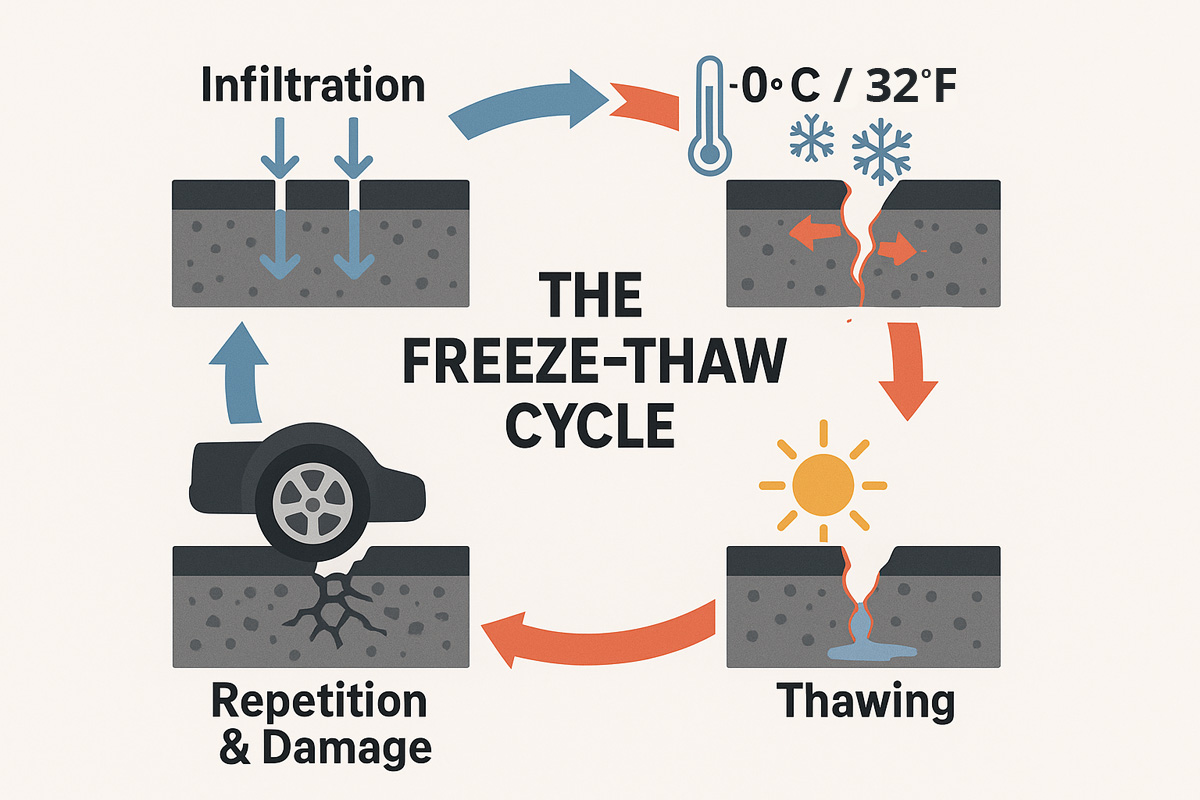
In cold-climate regions, a single kilometre of asphalt pavement can experience 50-100 freeze-thaw events every winter. Each event may seem insignificant, but together they account for billions of dollars in pavement‐related repair costs, traffic delays, and vehicle damage every year. Understanding the mechanics of freeze-thaw deterioration is the first step toward designing longer-lasting roads and scheduling smarter maintenance.
What Exactly Is the Freeze-Thaw Cycle?
-
Infiltration – Rain, snowmelt, or de-icing brine seeps into micro-cracks and surface voids in the pavement or the unbound layers below.
-
Freezing – When air or ground temperatures drop below 0 °C (32 °F), that trapped water crystallises and expands by roughly 9 %.
-
Pressure Build-Up – The expansion exerts outward pressure on asphalt binder, aggregate bonds, or PCC joints, prying them apart.
-
Thawing – As temperatures rise, ice returns to water, leaving behind a slightly larger void than before and allowing more moisture in.
-
Repetition – Dozens of cycles magnify tiny flaws into visible cracks, potholes, and structural failures.
Damage Pathways in Paved Roads
| Distress | How Freeze-Thaw Drives It | Visual Cue |
|---|---|---|
| Transverse & longitudinal cracking | Repeated internal pressure exceeds asphalt’s tensile strength; joints in PCC slabs widen and curl | Straight-line cracks perpendicular or parallel to traffic |
| Alligator (fatigue) cracking | Moisture weakens the underlying base, reducing load-bearing capacity and causing flexural fatigue | Interconnected, uneven “scale” or “chicken-wire” pattern |
| Potholes | Cracks admit brine → freeze-thaw loosens aggregate → traffic plucks pieces out | Bowl-shaped cavities that deepen rapidly |
| Raveling & loss of fines | Ice chisels out binder film and fine aggregate at the surface | Rough, pitted texture; loss of skid resistance |
| Frost heave & differential settlement | Ice lenses form in frost-susceptible subgrade, lifting pavement; when ice melts, voids collapse | Up-and-down undulations; raised humps in spring |
Factors That Intensify Freeze-Thaw Distress
-
Climate Severity – Higher “freeze-thaw index” (number of freeze-thaw cycles × temperature swing magnitude) accelerates damage.
-
Pavement Age & Condition – Oxidised asphalt (lower binder elasticity) and widened PCC joints invite infiltration.
-
Drainage Deficiencies – Poor shoulder grading, clogged edge drains, or low-permeability subbase trap water where it can freeze.
-
Material Properties
-
Asphalt: Excessive air voids (> 8 %) increase permeability.
-
Concrete: Insufficient air-entrainment (< 5 %) reduces space for ice expansion.
-
-
Traffic Loading – Heavy or slow-moving trucks force water deeper and break weakened bonds.
Detecting Freeze-Thaw Damage Early
| Tool | What It Reveals | When to Use |
|---|---|---|
| Visual PCI inspections | Surface cracking, potholes, raveling | Late winter / early spring |
| Infrared thermography | Saturation under pavement, hidden voids | During freeze events |
| Ground-penetrating radar (GPR) | Loss of base density, moisture pockets | Pre-overlay surveys |
| Falling weight deflectometer (FWD) | Structural capacity of weakened layers | After thaw but before heavy spring loads |
Design & Maintenance Strategies
Design Stage
-
Improved Drainage – Free-draining base courses, edge drains, permeable shoulders, positive ditch grades.
-
Robust Mix Design
-
Asphalt: polymer-modified binders, optimal air voids (4-7 %), anti-strip additives.
-
Concrete: proper air-entrainment, low w/c ratio, supplementary cementitious materials for durability.
-
-
Thermal-Crack Mitigation – Use wider PCC joint spacing with dowel baskets or asphalt overlay with PG-grade matched to local climate.
Maintenance Stage
-
Crack-Sealing & Fog-Sealing before first frost to block water pathways.
-
Timely Pothole Patching with hot mix or spray-injection to prevent edge growth.
-
Drainage Upkeep – Clean culverts, grade shoulders, repair curb inlets.
-
Seasonal Load Restrictions on weak granular roads during spring thaw.
-
Preventive Overlays or microsurfacing every 7-10 years to restore waterproofing.
The Cost of Inaction
Delaying crack sealing by even one winter can triple the area requiring repair the following spring. Studies in the U.S. Midwest show that every $1 spent on preventive freeze-thaw maintenance saves $4-$6 in heavy rehabilitation later on thanks to avoided base failure and user-delay costs.
Key Takeaways
-
Freeze-thaw damage is driven by water infiltration, ice expansion, and repeated cycles, not just low temperatures.
-
Distress starts microscopically; proactive detection and sealing can halt most progression.
-
Sound drainage, climate-appropriate materials, and tight maintenance timing form the best defence.
-
Pavement managers should align inspection schedules with climatic windows, late winter for surface cracks, post-thaw for structural testing, to stay ahead of costly failures.
For municipalities in temperate and cold regions, treating freeze-thaw deterioration as a predictable, manageable process, rather than an unavoidable act of nature, will stretch limited paving budgets and keep roads safer year-round.


Life-Cycle Assessment of Pavement Alternatives: Quantifying Environmental Impacts from Cradle to Grave

When Is the Best Time of Year to Sealcoat?

Poor Subgrade Support: Detecting and Fixing the Root of Premature Rutting

Developing a Pavement Rehabilitation Plan Based on PCI Data

Joint Resealing & Spall Repair for Concrete Roads
